
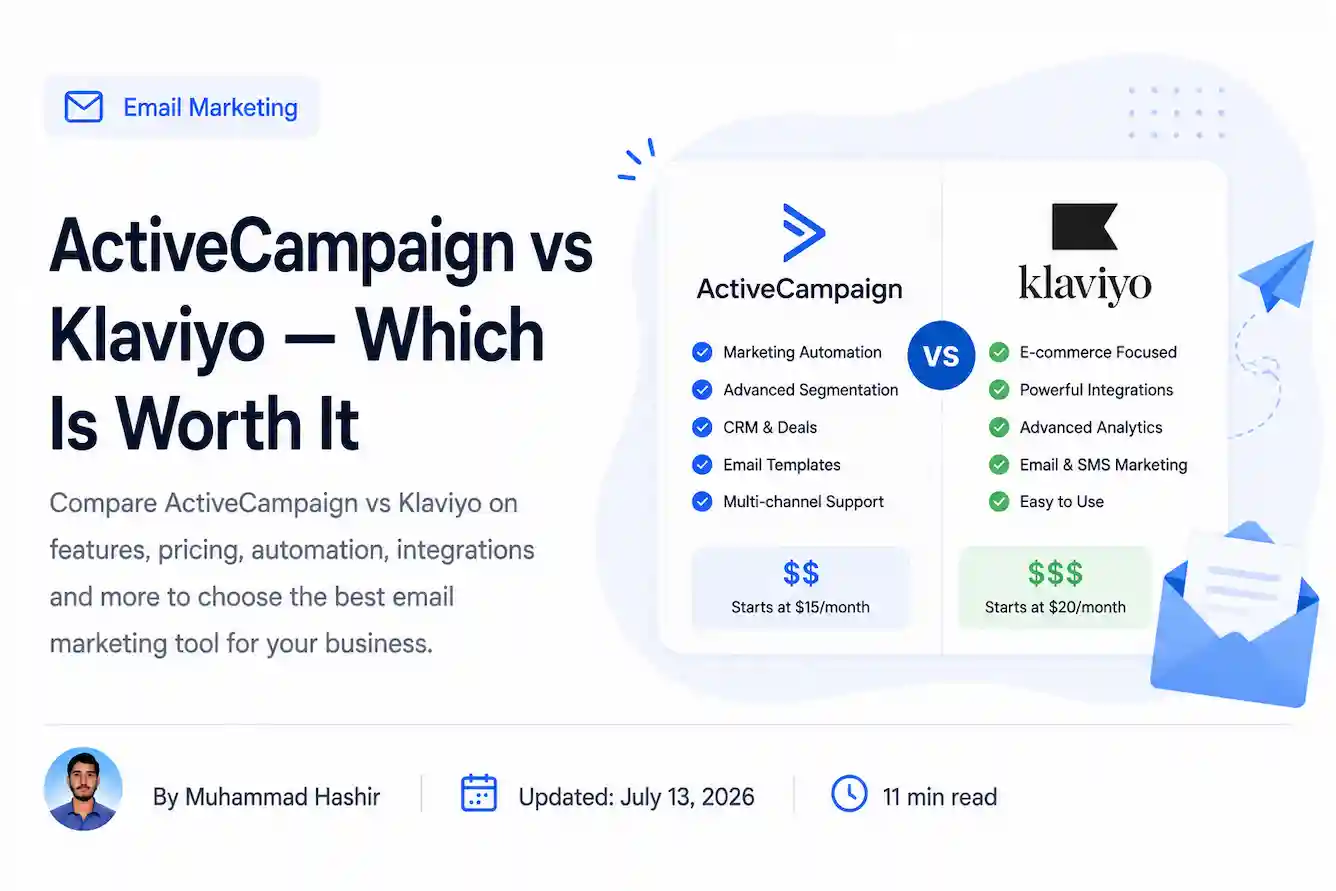
Both cost around $45-50 a month. Both show up on every “best email tool” list. That’s about where the similarities end. ActiveCampaign is built for service businesses and B2B teams running multi-step sales sequences tied to a CRM. Klaviyo is built for ecommerce, full stop, and it does that one job better than almost anything else out there. I’ve set up both for clients, and picking wrong doesn’t just cost money — it costs you months rebuilding a workflow you already thought was done. Here’s how to skip that mistake entirely.
Key Takeaways
Klaviyo is the better pick if you run an ecommerce store on Shopify, WooCommerce, or BigCommerce. Its deep store integrations, revenue attribution per email, and pre-built ecommerce flows — abandoned cart, browse abandonment, post-purchase — make it the category leader for product-based businesses at any meaningful scale.
ActiveCampaign is the better pick for service businesses, agencies, B2B companies, and consultants who need CRM-integrated sales automation. It ties email sequences directly to deal stages and contact scoring in a way Klaviyo doesn’t attempt.
At comparable list sizes, Klaviyo is more expensive than ActiveCampaign. For 2,500 contacts, Klaviyo Email runs roughly $60/month versus ActiveCampaign Starter at about $29-39/month — and that gap widens as your list grows.
Neither is a beginner tool. Both have learning curves that eat the first week of onboarding, and both will underdeliver if you try to use them the same way you used Mailchimp.
Quick Verdict — Which Should You Pick
If you sell physical or digital products online and Shopify, WooCommerce, or BigCommerce is involved, pick Klaviyo. If you sell services, run a B2B business, do consultancy work, or run an agency where client pipeline management and email automation need to work together — pick ActiveCampaign. That’s the whole decision for 90% of people reading this.
If neither of these platforms fits your budget or use case, our best email marketing software for small business covers the full range from MailerLite at nine dollars a month up to enterprise options.
Why This Isn’t a Tight Race
The original observation that most ActiveCampaign vs Klaviyo comparisons miss: these two platforms don’t really compete for the same business. They ended up on the same comparison lists because they’re both “advanced” email marketing tools priced above the entry tier — not because they serve overlapping use cases. Klaviyo has spent years building ecommerce infrastructure: predictive analytics on purchase behavior, Shopify sync that updates in real time, and revenue dashboards that tell you exactly which campaign drove which sale. ActiveCampaign has spent years building service automation infrastructure: visual workflow builders, CRM deal stages tied to email sequences, lead scoring, and conditional branching logic for complex B2B sales cycles. Choosing between them based on a feature-count spreadsheet is the wrong frame. Choose based on what your business actually sells.
ActiveCampaign Overview — Strengths and Weaknesses
ActiveCampaign is the strongest email marketing + CRM combo for service-based businesses that need their email automation to plug directly into a sales pipeline. It’s not just an email tool — the CRM and automation are genuinely integrated rather than bolted together, which makes it the most capable platform in this price range for B2B and service workflows.
Pricing and Plans
ActiveCampaign’s Starter plan runs $15/month for 1,000 contacts (annual billing) or $19/month on monthly billing — the cheapest entry point at this capability level. At 2,500 contacts, Starter is roughly $29-39/month annually. At 5,000 contacts, you’re looking at approximately $49/month. Plus, the next tier, starts at $49/month for 1,000 contacts annually and adds CRM with deals, landing pages, and Facebook custom audience sync. Professional at $79/month for 1,000 contacts (annual) unlocks predictive sending (the system automatically picks the best time to send each email based on individual subscriber behavior) and site messaging.
One important note: ActiveCampaign scales pricing by contact count, so those rates shift as your list grows. A 10,000-contact account on Starter runs roughly $110-130/month annually. Always check the current pricing calculator on their site before committing a large list.
What Makes ActiveCampaign Actually Worth the Price
The visual automation builder is the reason people stick with ActiveCampaign. You can build workflows where a prospect fills out a form, gets tagged based on which page they came from, enters a 5-email education sequence, gets scored based on opens and clicks, and when their score hits a threshold, a task gets created for a sales rep in the CRM and the email sequence shifts to a sales-oriented track. All of that in one connected workflow. That kind of conditional branching logic — where different actions trigger different paths — is where ActiveCampaign outclasses Mailchimp, MailerLite, and even Kit at every comparable price point.
Lead scoring (the feature that automatically ranks contacts by how likely they are to convert based on their email behavior, site visits, and form interactions) is available on Plus and above. For a B2B company with a longer sales cycle, that score becomes the signal that tells your sales team which prospects are ready for a call without requiring them to manually review campaign activity.
Where ActiveCampaign Falls Short
The onboarding curve is real. Most ActiveCampaign users spend the first week clicking through menus before anything is actually running. The interface has improved, but it’s still more complex than Mailchimp or MailerLite, and first-time users without a clear workflow plan often build automations that overlap, create loops, or fire in unintended sequences. The ecommerce features exist on all plans, but they’re thin — basic abandoned cart emails require a third-party integration, and there’s no native revenue attribution dashboard. For a Shopify store, you’re fighting the tool rather than using it as designed. ActiveCampaign is frequently compared to Mailchimp by businesses stepping up from basic email — our Mailchimp alternatives guide covers where ActiveCampaign sits in that comparison and whether the price jump is worth it.
Klaviyo Overview — Strengths and Weaknesses
Klaviyo is the most complete email marketing platform for ecommerce, full stop. Its Shopify and WooCommerce integrations sync product data, purchase history, browsing behavior, and real-time cart activity directly into your email logic, which makes it possible to build automation flows that no generic email tool can replicate at the same precision.
Pricing and Plans
Klaviyo’s free plan covers 250 contacts and 500 email sends per month — basically a demo tier. Paid Email plans start at $45/month for 1,001-1,500 contacts, $60/month for 1,501-2,500 contacts, $100/month for 2,501-5,000 contacts, and $175/month for 5,001-10,000 contacts. The Email + SMS plan runs higher — roughly $60/month at 1,001-1,500 contacts, adding SMS marketing credits on top of the email fee.
Klaviyo’s pricing is contact-count based, but the real differentiator is that every plan gets the same feature access — you’re not paying to unlock automation or segmentation, you’re just paying for the contact tier. That’s different from ActiveCampaign, where moving from Starter to Plus unlocks real functionality. At Klaviyo, two businesses with 1,500 contacts have identical feature access regardless of which paid tier they land on.
The Ecommerce Automation Nobody Else Matches
A Klaviyo abandoned cart flow doesn’t just send a generic “you left something behind” email — it pulls the exact product the person was looking at, their browsing history on your site, their purchase history if they’re an existing customer, and adjusts the copy and discount logic accordingly. Browse abandonment flows (emails triggered when someone looks at a product but doesn’t add it to cart) add another layer that most email tools don’t even attempt. Post-purchase sequences can be split by product category, purchase value, or first-time versus returning customer, creating entirely different experiences in the same automation tree.
Revenue attribution — tracking the exact revenue generated by each email campaign or automation flow, down to the dollar — is built into the dashboard natively. That data tells you which flows are actually generating money and which ones are just generating opens, which changes how you prioritize your marketing calendar in a real, measurable way.
Where Klaviyo Falls Short
Klaviyo is expensive for what you get if you’re not running an ecommerce store. A service business on Klaviyo at $100/month for 5,000 contacts is paying for ecommerce infrastructure they’ll never use — there’s no native CRM, no deal stage tracking, and the automation logic is built around purchase events rather than service-business triggers like form completions, consultation bookings, or proposal views. Deliverability has also drawn complaints from some users on shared sending infrastructure at higher volumes, though Klaviyo’s dedicated sending options on higher tiers address this. The learning curve is comparable to ActiveCampaign — neither of these tools is a quick afternoon setup.
Pricing Compared Side by Side
Here’s what each platform actually costs at common contact list sizes, based on verified July 2026 pricing, annual billing throughout.
Cost Comparison by List Size
| Contact Count | ActiveCampaign Starter | ActiveCampaign Plus | Klaviyo Email | Klaviyo Email + SMS |
| 1,000 | $15/mo | $49/mo | $45/mo (1K-1.5K tier) | ~$60/mo |
| 2,500 | ~$29-39/mo | ~$79/mo | $60/mo | ~$80/mo |
| 5,000 | ~$49/mo | ~$149/mo | $100/mo | ~$130/mo |
| 10,000 | ~$110/mo | ~$229/mo | $175/mo | ~$230/mo |
The pattern: at smaller list sizes (under 2,500 contacts), ActiveCampaign Starter is meaningfully cheaper than Klaviyo Email. As lists grow past 5,000-10,000 contacts, the pricing converges — and the feature access on Klaviyo (which doesn’t gate automation by plan) can actually make it better value than ActiveCampaign Plus at the same contact count for a business that needs all features from the start.
Which One Is Right for Your Business
The decision is cleaner than most comparisons make it look.
Run an Ecommerce Store? Klaviyo.
If revenue attribution matters — and it should, because knowing which campaign drove $4,200 in sales is the difference between scaling what works and wasting budget on what doesn’t — Klaviyo’s native store integrations make the $60-100/month justifiable within the first month for a store doing consistent volume. A Shopify store generating $20,000/month in revenue should be spending $100-200/month on email marketing if it’s doing its job properly; Klaviyo’s attribution will show you whether it is.
Run a Service, Agency, or B2B Business? ActiveCampaign.
A consultant running a 3-step onboarding sequence, a real estate agency routing leads through a qualification workflow, or a SaaS company nurturing trial users toward conversion — these are all ActiveCampaign use cases where the CRM integration and conditional automation logic earn the subscription cost immediately. The Plus plan at $49/month for 1,000 contacts gives you the CRM deal stages and lead scoring that transform email from a broadcast tool into a sales operation.
What If You’re a Creator or Newsletter Operator?
Neither Klaviyo nor ActiveCampaign is the right tool for you. Klaviyo is ecommerce. ActiveCampaign is service/B2B automation. For newsletters and content monetization, Kit (formerly ConvertKit) at $39/month for 1,000 subscribers gives you better creator-focused features than either platform at a comparable price, without paying for infrastructure designed for selling physical goods or managing B2B pipelines. For creators and newsletter operators who do not need ecommerce automation, our Mailchimp vs ConvertKit comparison covers the platforms built specifically for that audience at lower price points than either of these.
The Migration Question
Switching from one to the other isn’t complicated mechanically — CSV export, CSV import, rebuild your automations. The rebuilding is where the time cost sits. If you’ve spent three months building Klaviyo flows and you’re considering moving to ActiveCampaign because you expanded into services, budget 2-3 full days of rebuild time rather than a quick afternoon. Same in reverse. The data transfers; the logic doesn’t.
Frequently Asked Questions
What is the main difference between ActiveCampaign and Klaviyo?
ActiveCampaign is built for service businesses and B2B companies that need email automation tied to a CRM and sales pipeline, while Klaviyo is built specifically for ecommerce businesses that need deep store integrations, purchase-behavior automation, and revenue attribution per campaign.
Is Klaviyo better than ActiveCampaign for Shopify?
Yes — Klaviyo’s native Shopify integration syncs real-time cart, purchase, and browsing data directly into email logic, enabling abandoned cart flows, browse abandonment sequences, and post-purchase automation that ActiveCampaign can only partially replicate through third-party connectors.
Is ActiveCampaign cheaper than Klaviyo?
At smaller list sizes (under 2,500 contacts), ActiveCampaign Starter is meaningfully cheaper — roughly $29-39/month versus Klaviyo’s $60/month at 2,500 contacts. As lists grow past 10,000 contacts, the pricing converges significantly.
What are the best Klaviyo alternatives?
Omnisend is the strongest direct Klaviyo alternative for ecommerce at a lower price point, while Drip is a close competitor focused on independent ecommerce brands. For non-ecommerce businesses, Brevo or ActiveCampaign are more appropriate alternatives depending on automation complexity needed.
Can ActiveCampaign work for ecommerce?
Technically yes — ActiveCampaign has ecommerce integrations and supports abandoned cart emails via third-party connectors. In practice, the ecommerce infrastructure is significantly less capable than Klaviyo’s native store sync, and a store doing serious email marketing will hit the limitations within the first month.
Is Klaviyo worth it for small ecommerce stores?
Klaviyo’s $45/month entry price makes sense once your store generates consistent monthly revenue where email contributes meaningfully. For a store making under $5,000/month, the attribution data is useful but the cost is harder to justify — Omnisend at a lower price point covers the core ecommerce flows at that stage without the Klaviyo premium.
How does ActiveCampaign compare to Mailchimp?
ActiveCampaign offers significantly more complex multi-step automation than Mailchimp at every plan level, built-in CRM features on Plus and above, and lead scoring that Mailchimp doesn’t match — but it costs more and requires more setup time, making Mailchimp the easier starting point and ActiveCampaign the natural upgrade for businesses that have outgrown basic campaign sending.
Conclusion
The answer is straightforward: if your business sells products online, go Klaviyo. If your business sells services, time, or expertise, go ActiveCampaign’s Plus plan at $49/month for 1,000 contacts so you get the CRM deal stages and lead scoring that actually make the automation useful beyond just sending emails. Paying for either without a clear plan for what automations you’ll build in the first 30 days is the fastest way to end up paying $100/month for a tool that does exactly what MailerLite would have done at $9/month. For the full picture on which email platform fits where in the overall stack, our breakdown of the best email marketing software for small business compares every major option side by side including MailerLite, Brevo, Kit, and Mailchimp with current 2026 pricing.