
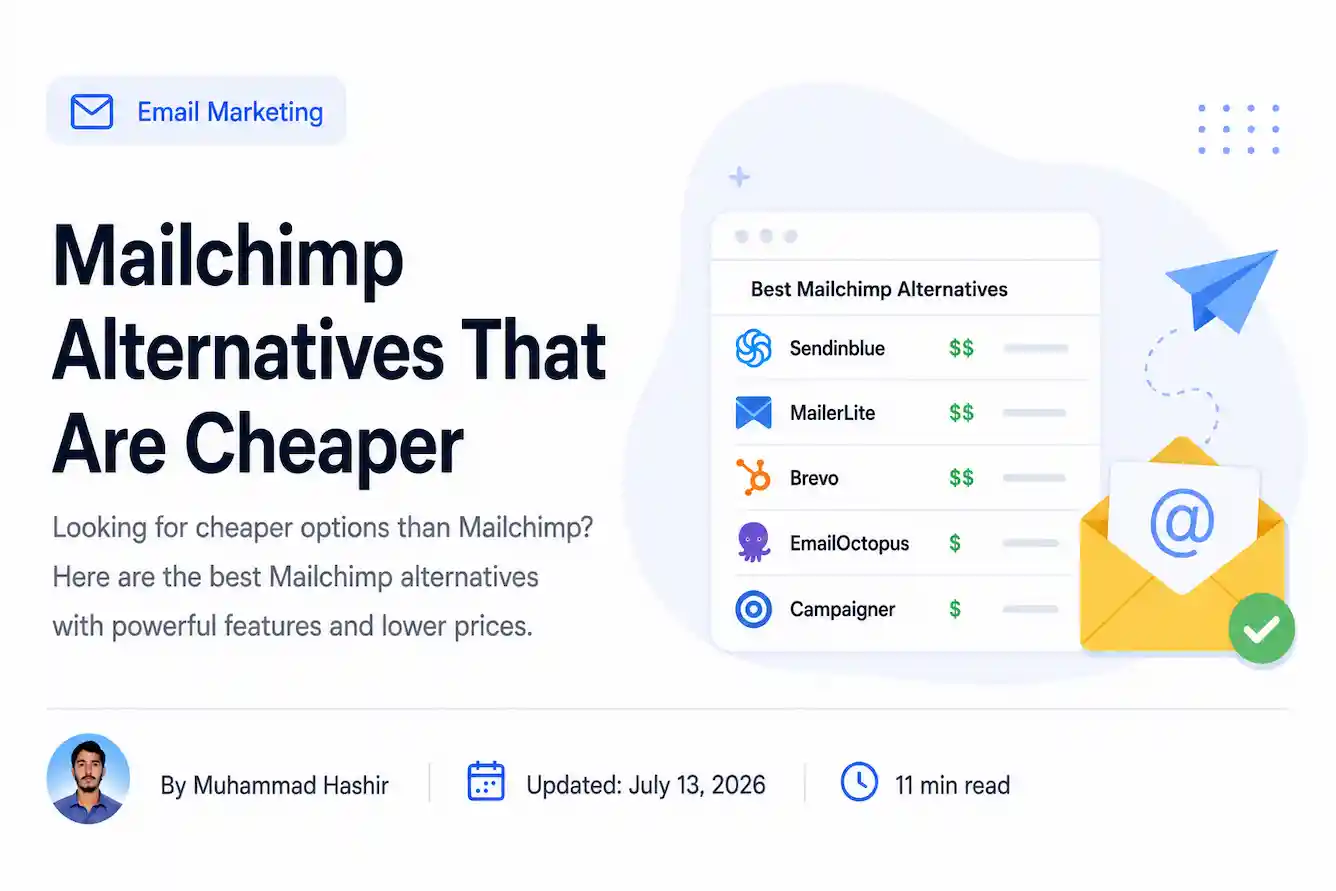
Mailchimp used to be the default. Then it got acquired, the free tier shrank to 250 contacts with zero automation, and prices climbed over 30% since 2022. If you’re still there out of habit, not loyalty, you’re probably overpaying for less than what’s available elsewhere right now. Switching takes less than an afternoon — genuinely, I’ve done it for clients while they were on a lunch break. Here’s exactly where to move, depending on what you actually need.
Key Takeaways
MailerLite is the best overall cheaper Mailchimp alternative — it costs $9/month for 1,000 subscribers versus Mailchimp Essentials at roughly $17/month for the same list, and includes full multi-step automation that Mailchimp gates behind its $20+/month Standard plan.
Brevo is the strongest alternative if your contact list is large but you don’t email frequently. Pricing by sends rather than contacts means a business with 20,000 contacts sending monthly pays $25/month on Brevo versus roughly $270/month on Mailchimp Standard.
Mailchimp charges for unsubscribed contacts — most alternatives don’t. A business with a 10,000-contact list where 3,000 have unsubscribed is paying for all 10,000 on Mailchimp; MailerLite, Brevo, and Kit only count active subscribers.
Migrating your list away from Mailchimp takes about an hour. Every major alternative supports CSV import of your subscriber list and tags, so the switching cost is lower than most people assume.
Why People Leave Mailchimp
Mailchimp was the default recommendation for small business email marketing for most of the 2010s — and for good reason. It had a genuinely free plan (2,000 contacts and 12,000 sends), a polished email builder, and enough automation to cover basic sequences. That version of Mailchimp no longer exists.
The Free Plan Has Been Gutted
Mailchimp’s free plan in July 2026 allows 250 contacts and 500 monthly email sends with a 250-email daily cap, no scheduling, no automation, and Mailchimp branding on every email. That’s down from 2,000 contacts in 2022. For any small business actually trying to build a list and send regular emails, the 2026 free plan runs out within the first month of real use. This is the single biggest driver of people searching for alternatives — they signed up for the generous free plan that no longer exists and feel misled by reviews referencing old limits. For the full picture on how Mailchimp compares to ConvertKit before switching, our Mailchimp vs ConvertKit comparison covers the January 2026 free plan cut and September 2025 Kit price increase side by side.
Pricing Has Climbed 30%+ Since 2021
Since Intuit’s 2021 acquisition, Mailchimp’s Essentials plan went from $9.99 to $13 at the 500-contact tier, Standard went from $14.99 to $20, and Premium climbed from $299 to $350 at the base tier. Multi-step automation — which was previously available on lower plans — is now Standard-only. For a business that signed up three years ago expecting one pricing model and is now on a higher plan, the gap feels even wider.
The Unsubscribed-Contact Billing Trap
The original observation that most “Mailchimp alternatives” articles skip: Mailchimp counts unsubscribed contacts toward your billing tier unless you manually archive them. A business that’s collected emails for three years and has accumulated 5,000 total contacts, including 2,000 who unsubscribed, is paying for 5,000 contacts. Most alternatives — MailerLite, Brevo, Kit — only bill for active, deliverable subscribers. That difference alone can represent a $30-60/month hidden overcharge on Mailchimp, depending on list history.
Best Overall Alternative — MailerLite
MailerLite is the best overall Mailchimp alternative for most small businesses because it’s cheaper at every list size, includes automation on both its free and paid tiers, and its email builder handles everything the majority of small businesses actually need. Its Growing Business plan costs $9/month for up to 1,000 subscribers — versus Mailchimp Essentials at roughly $17/month for the same list — and includes multi-step automation that Mailchimp only offers on Standard at $26/month for 1,000 contacts.
What You Get on MailerLite Free and Paid
MailerLite’s free plan covers 1,000 subscribers and 12,000 monthly email sends with automation workflows, A/B testing, signup forms, and landing pages included at no cost. That free tier alone outperforms Mailchimp’s paid Essentials plan on automation and contacts. Growing Business pricing scales: $9/month at 1,000 subscribers, $19/month at 2,500, $32/month at 5,000, and $57/month at 10,000 — all with full automation included, no tier upgrade required. Annual billing saves about 17% across plans.
MailerLite is also the top pick in our best email marketing software for small business roundup — that guide compares it against Klaviyo, Brevo, and Kit with real 10-person team cost examples.
Where MailerLite Falls Short vs Mailchimp
MailerLite’s email template library is thinner than Mailchimp’s — fewer pre-built designs and less visual design flexibility for complex promotional emails. If you’re a product brand running heavy visual campaigns with multi-column layouts and product blocks, the design gap is noticeable. For a service business, newsletter, or consultant sending text-heavy or moderately designed emails, it’s irrelevant. MailerLite also doesn’t have Mailchimp’s depth of ecommerce integrations — if your core use case is abandoned cart emails and post-purchase sequences directly from your Shopify store, MailerLite is a step behind Mailchimp (and Klaviyo is a step ahead of both).
Best Free Alternative — Sender or Zoho Campaigns
For businesses specifically looking for a free Mailchimp alternative with more than 250 contacts, both Sender and Zoho Campaigns beat Mailchimp’s 2026 free tier substantially.
Sender
Sender’s free plan covers 2,500 subscribers and 15,000 emails per month — six times more contacts and thirty times more sends than Mailchimp’s 2026 free tier — with basic automation, email templates, and no Sender branding on emails. It’s the most generous free plan for pure email sending among the platforms on this list. Sender’s paid plans start at around $8/month for 2,500 subscribers, staying cheaper than Mailchimp at every comparable list size. If your main priority is finding a free platform with no contact cap, our best free email marketing tools with no subscriber limit covers Brevo and Mailjet which allow unlimited contact storage at zero cost.
The honest limitation: Sender is a smaller platform with less ecosystem integration than Mailchimp, MailerLite, or Brevo. If you rely on specific third-party integrations (Shopify, WordPress, Zapier workflows), confirm your stack is supported before migrating a large list to Sender.
Zoho Campaigns
Zoho Campaigns’ free plan supports 2,000 contacts and 6,000 monthly email sends, which is still eight times more contacts than Mailchimp’s current free tier. The free tier includes basic automations and fits naturally into the Zoho ecosystem — if you’re already using Zoho CRM or Zoho Books, Campaigns integrates natively without any data sync setup. Paid plans start at $3/month for 500 contacts on Standard (scaling based on list size), making it one of the cheapest paid options available.
The limitation: Zoho Campaigns’ interface and template library feel dated compared to MailerLite or Mailchimp. If visual email design matters to you, it’s a friction point from day one.
Best for Large Lists — Brevo
Brevo (formerly Sendinblue) is the best Mailchimp alternative specifically for businesses with large contact lists that send infrequently. Its Starter plan at $25/month covers 20,000 email sends per month with unlimited contacts — Mailchimp Standard for 20,000 contacts costs roughly $270/month. That’s a $245/month gap on the same list size and send volume, which is a real number worth calculating before your next billing cycle.
Why Send-Based Pricing Changes Everything at Scale
A clear stance: contact-based pricing (what Mailchimp uses) creates a predictable squeeze as your list grows, regardless of whether your email performance improves. Send-based pricing (what Brevo uses) decouples list size from cost, so a business that’s spent two years building a 15,000-contact list but only emails monthly pays for the sends, not the storage. For large-list businesses with moderate send frequency, Brevo consistently undercuts every contact-based competitor.
Where Brevo Falls Short
Brevo’s email template library and drag-and-drop builder are functional but not as polished as MailerLite or Mailchimp for visual email design. Its automation on the Starter plan is also limited — multi-step behavioral automation requires the Business tier at $65/month, which is a genuine paywall for businesses needing sophisticated sequences. And Brevo’s interface has a steeper initial learning curve than MailerLite for non-technical users, which slows the first few weeks of onboarding.
Best for Automation Depth — ActiveCampaign
ActiveCampaign is the best Mailchimp alternative for businesses that have outgrown basic automation and need complex, behavior-driven sequences — lead scoring, conditional branching, CRM-integrated workflows — without an enterprise price tag. Its Starter plan begins at around $15/month for 1,000 contacts (annual billing), making it comparable to MailerLite on price but offering significantly deeper automation logic and built-in CRM functionality.
Who Actually Needs ActiveCampaign
A service business running multi-step onboarding sequences, an agency managing marketing for clients with different automation rules, or any business where email automation is central to sales pipeline management benefits from ActiveCampaign’s depth. The visual automation builder is more capable than anything Mailchimp offers at any price point, including Premium.
The Honest Tradeoff
ActiveCampaign is more complex than MailerLite or Mailchimp to set up. First-time users typically spend the first week learning the automation builder rather than sending campaigns. For a business that doesn’t need sophisticated automation — just newsletters, basic welcome sequences, and occasional broadcast emails — that setup cost isn’t worth it. Start with MailerLite and migrate to ActiveCampaign when you’ve genuinely outgrown the simpler automation logic.
How These Compare on Price
Here’s the real cost comparison across all major Mailchimp alternatives at common list sizes, based on verified July 2026 pricing.
Monthly Pricing by List Size
| Platform | 500 contacts | 1,000 contacts | 2,500 contacts | 5,000 contacts | 10,000 contacts |
| Mailchimp Essentials | $13 | ~$17 | ~$45 | ~$75 | ~$110 |
| Mailchimp Standard | $20 | ~$26 | ~$60 | ~$100 | ~$135 |
| MailerLite Growing | $9 | $9 | $19 | $32 | $57 |
| Brevo Starter | $25 (20K sends) | $25 | $25 | $25 | $25 |
| Sender | ~$8 | ~$8 | ~$15 | ~$25 | ~$35 |
| Zoho Campaigns | $3 | $5 | $12 | $22 | $35 |
| Kit Creator | $39 | $39 | $59 | $89 | $139 |
| ActiveCampaign Starter | $15 | $15 | $29 | $49 | $93 |
MailerLite saves $4-78/month versus Mailchimp at every list size from 500 to 10,000 contacts. Brevo’s flat $25/month Starter rate becomes the cheapest option once your list exceeds 3,000 contacts if you only email once a month. Zoho Campaigns is cheapest per contact but trades design quality and integration depth to get there.
Savings Over One Year
| Migration | Annual Savings vs Mailchimp Standard at 5,000 contacts |
| Switch to MailerLite | ~$816/year ($100 → $32/mo) |
| Switch to Brevo | ~$900/year ($100 → $25/mo) |
| Switch to Sender | ~$900/year ($100 → ~$25/mo) |
| Switch to Zoho | ~$936/year ($100 → ~$22/mo) |
Frequently Asked Questions
What is the best free alternative to Mailchimp in 2026?
Sender’s free plan (2,500 subscribers, 15,000 sends/month) and MailerLite’s free plan (1,000 subscribers, 12,000 sends/month, automation included) are both significantly more generous than Mailchimp’s 2026 free tier of 250 contacts and 500 sends.
Is MailerLite better than Mailchimp for small business?
Yes, for most small businesses — MailerLite costs roughly half what Mailchimp charges at every comparable list size, includes full multi-step automation on both free and paid plans, and only bills for active subscribers rather than charging for unsubscribed contacts like Mailchimp does.
What is the cheapest alternative to Mailchimp?
Zoho Campaigns has the lowest paid plan pricing starting around $3/month for 500 contacts, and Sender offers the most generous free tier at 2,500 subscribers; for the best balance of price and features, MailerLite at $9/month for 1,000 subscribers is the most cost-effective pick for most small businesses.
Is Brevo (formerly Sendinblue) a good Mailchimp alternative?
Yes, especially for businesses with large contact lists that email infrequently — Brevo’s Starter plan at $25/month covers 20,000 email sends per month with unlimited contacts, which undercuts Mailchimp Standard’s $270/month for the same 20,000-contact list by an enormous margin.
Does switching from Mailchimp to an alternative mean losing your subscriber list?
No — Mailchimp allows CSV export of your full subscriber list including tags and segments, and every major alternative (MailerLite, Brevo, Kit, ActiveCampaign) supports CSV import, so migration typically takes less than an hour of actual work.
Is ActiveCampaign cheaper than Mailchimp?
At entry-level list sizes (500-1,000 contacts), ActiveCampaign Starter ($15/month) is cheaper than Mailchimp Standard ($20-26/month) and offers significantly deeper automation logic, making it the better value specifically for businesses that rely on complex behavioral email sequences.
What is the best Mailchimp alternative for a nonprofit?
MailerLite offers a 30% discount for verified nonprofits on paid plans, and Brevo’s send-based pricing model is particularly favorable for nonprofits with large membership lists that send infrequent updates — both outperform Mailchimp’s 15% nonprofit discount, which is the lowest in the industry.
Conclusion
If you want the direct answer: switch to MailerLite. It’s the cleanest migration from Mailchimp, it’s meaningfully cheaper at every list size, and the feature gap is minimal for most small business email workflows. Move to Brevo if your contact list is large and your send frequency is low — the per-send pricing model will save you hundreds of dollars a year at scale. The one case where Mailchimp still holds its ground is ecommerce businesses deeply integrated with Shopify’s ecosystem, and even there, Klaviyo is the more capable tool. For the full breakdown of every major email marketing platform with side-by-side pricing, our roundup of the best email marketing software for small business covers all options in one place.