
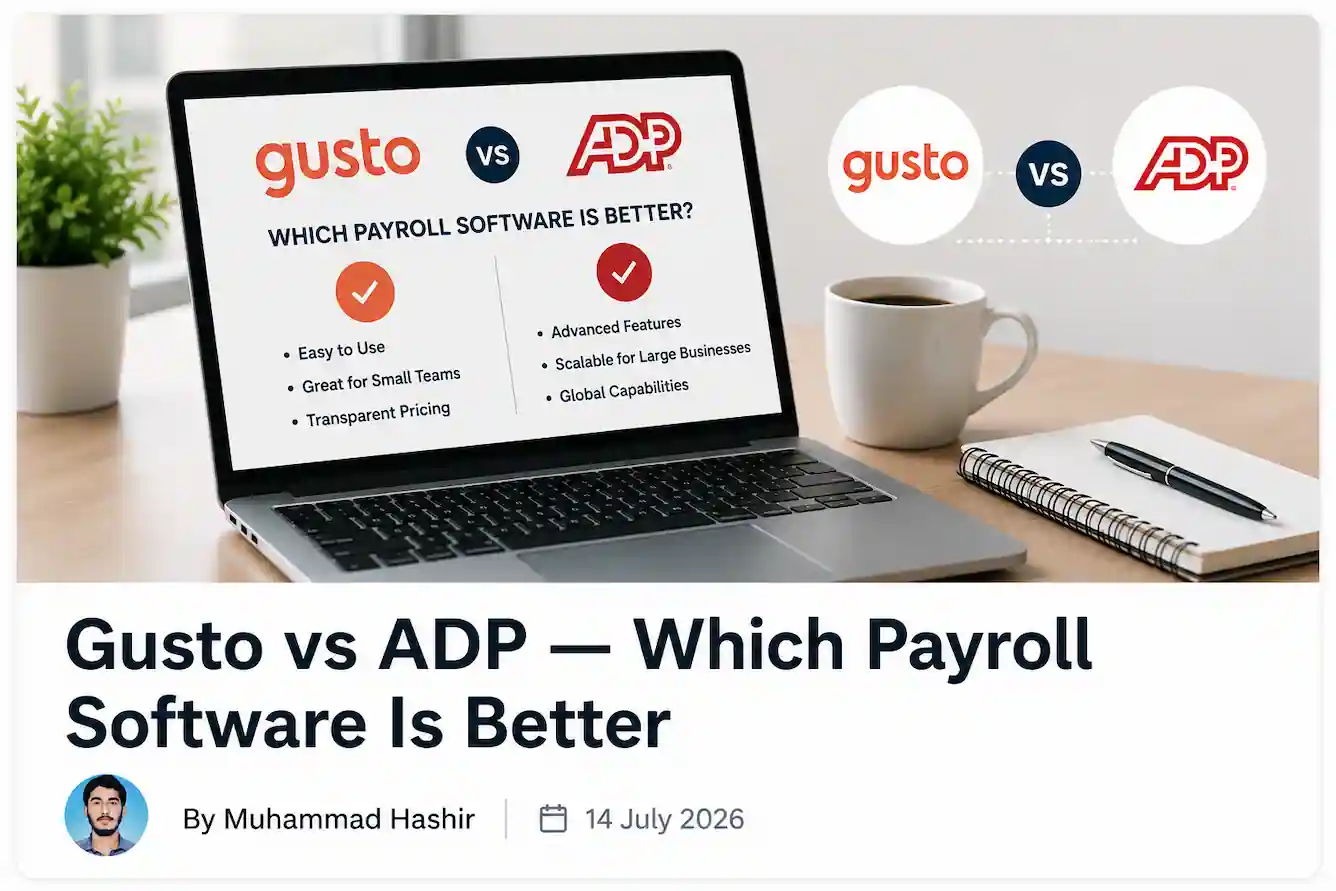
Your accountant mentioned ADP. Your friend who runs a 20-person company swears by Gusto. You’ve tried requesting ADP pricing and got a callback from a sales rep who wanted to schedule a demo before giving you a number. Meanwhile, Gusto’s pricing is right there on their website. That difference alone tells you something meaningful about who each platform is built for. Gusto vs ADP is a real decision small business owners face — and the answer for most of them is pretty clear once you understand what ADP’s pricing structure actually looks like versus what you’re being quoted.
Key Takeaways
Gusto wins for small businesses under 50 employees — it has transparent public pricing, no per-run charges, and includes W-2/1099 filing at no extra cost. Gusto Simple runs $49/month + $6/employee after the March 2026 price increase, and every fee is disclosed before you sign up.
ADP does not publish pricing — every quote is custom, and the hidden fees (per-payroll-run charges on some plans, W-2 delivery fees, garnishment processing fees) make the real monthly cost significantly higher than the quoted base rate for most small businesses.
ADP earns its complexity for businesses above 50 employees, multi-entity companies, and organizations needing enterprise HR compliance support that Gusto’s Premium plan doesn’t match on depth.
For the majority of small businesses comparing these two, Gusto is the right answer. ADP’s enterprise infrastructure is solving problems a 10-person company doesn’t have.
Quick Verdict — Which Should You Pick
For any small business under 50 employees that needs straightforward full-service payroll, Gusto is the better choice. Transparent pricing, no per-run fees, year-end W-2 and 1099 processing included, and an interface business owners can navigate without a payroll background. ADP is the right call specifically for businesses that have outgrown modern payroll platforms — complex multi-state compliance situations, union workforce rules, or integration requirements with legacy HR systems that only ADP supports. That profile describes a mid-market company, not a 15-person service business.
If Rippling has also come up in your research as a more complete platform than either Gusto or ADP, our Rippling vs Gusto full comparison covers the modular pricing trap and exactly when Rippling earns its premium.
The Pricing Transparency Problem
The original observation this comparison needs to state directly: ADP’s refusal to publish pricing is not just a sales tactic — it’s a structural disadvantage for small business buyers who don’t know what comparable payroll should cost. A small business owner who accepts an ADP quote without comparing Gusto, OnPay, or Paychex often ends up paying 40-80% more than they would on a modern platform for identical payroll functionality. The lack of published pricing means the final number depends on how hard you negotiate with a sales rep, not on what the service actually costs to deliver. That’s a power dynamic you don’t want to be on the wrong side of.
Gusto Overview — Strengths and Weaknesses
Gusto is the market leader for small business payroll in the US, serving over 400,000 businesses as of 2026. Its core proposition is simple: full-service payroll (the software calculates, files, and pays all your federal, state, and local payroll taxes on your behalf) in a clean browser-based interface with no payroll background required and no annual contract.
Current 2026 Pricing — Post-March Increase
Gusto raised its Simple plan base fee from $40 to $49 in March 2026. Current plans:
- Simple: $49/month + $6/employee — single-state payroll, basic HR, employee self-service, health insurance administration
- Plus: $80/month + $12/employee — multi-state payroll, next-day direct deposit, time tracking, workforce costing
- Premium: $180/month + $22/employee — HR advisors, compliance alerts, dedicated support, performance reviews
- Contractor Only: $35/month + $6/contractor — 1099 payments, no W-2 payroll
All plans include unlimited payroll runs (off-cycle payrolls for bonuses, corrections, or terminations cost nothing extra), W-2 and 1099 year-end processing, and employee new-hire state reporting. No per-run charges. No year-end form fees.
Real monthly costs at common team sizes:
- 5 employees on Simple: $79/month
- 10 employees on Simple: $109/month
- 15 employees on Plus: $260/month
- 20 employees on Plus: $320/month
Why Gusto Works for Small Business
The interface. Seriously — a business owner with no payroll experience can run their first payroll in under an hour, not three weeks. Automated tax filing means you never have to calculate quarterly 941 deposits or track state withholding deadlines. Employee self-service lets your team update their own direct deposit and W-4 information without you forwarding PDFs. And Gusto integrates natively with QuickBooks Online, Xero, and FreshBooks so your books stay current without manual journal entries.
Where Gusto Falls Short
Gusto raised its Simple base fee 23% in March 2026, which narrows its cost advantage. Support quality on lower tiers is the most consistent criticism across user reviews — priority support requires the Premium plan at $180/month, and small businesses on Simple often wait longer than they’d like for issue resolution. Gusto also has a hard multi-state wall: you cannot process payroll for employees in more than one state on the Simple plan, and the forced upgrade to Plus doubles your per-employee cost the moment you hire across a state line. And for businesses with complex hourly workforces — shift scheduling, tip pooling, union rules — Gusto’s tools are insufficient without a dedicated scheduling platform running alongside.
For the full payroll market beyond just these two platforms, our best payroll software for small business covers OnPay, Square Payroll, and QuickBooks alongside Gusto with verified 2026 pricing.
ADP Overview — Strengths and Weaknesses
ADP is the largest payroll company in the world by revenue and serves businesses of every size, from sole proprietors to Fortune 500 companies. For small businesses, it operates through ADP RUN, a version of its platform sized for teams under 50 employees. ADP’s depth in compliance, HR, and workforce management is genuine — the question is whether that depth is worth the cost and complexity for a small business that could run on a simpler platform.
ADP Pricing — What You Actually Pay
ADP does not publish pricing for RUN. The quote you receive depends on your team size, state, features selected, and how the sales conversation goes. Based on widely reported small-business accounts, ADP RUN Essential (the entry plan) typically runs $80-120/month + $4-6/employee for a 5-10 person team. Enhanced and Complete tiers run higher.
The more important number is the total cost including fees most sales quotes don’t lead with:
- Per-payroll-run fees: Some ADP RUN plans charge per run, which adds $12-25 for each payroll cycle on top of the base fee — unlike Gusto, where unlimited runs are included at every tier
- W-2 delivery fees: ADP sometimes charges $1-3 per W-2 delivered to employees at year-end — on a 25-person team, that’s $25-75 added to your January bill
- Garnishment processing fees: ADP charges $5-15 per garnishment payment per state — Gusto includes garnishment processing at no additional cost
- Year-end processing: Some ADP plans include this; others bill it as an additional service
A small business on ADP paying for biweekly payroll (26 runs/year), with standard W-2 delivery and one garnishment, can find its actual annual cost 15-30% higher than the quoted base rate. Always request an all-in quote including every fee category before signing.
Where ADP Genuinely Wins
ADP’s compliance infrastructure runs deeper than Gusto’s at scale. For a business with 75+ employees, complex multi-state filings, or industry-specific requirements (union payroll, Davis-Bacon prevailing wage, healthcare benefits compliance), ADP has resources Gusto’s Premium plan doesn’t match. Its ADP HR Pro add-on gives access to HR advisory services that go well beyond what Gusto’s HR advisors offer. ADP also has enterprise-grade integrations with legacy accounting and ERP systems that matter for a company running SAP or Oracle — which again, is not a small business problem.
Where ADP Falls Short for Small Business
The pricing opacity is the main issue. A small business owner shouldn’t need to negotiate with a sales rep just to find out what payroll costs. The per-run fees and year-end charges that show up after the base quote create a total-cost-of-ownership that consistently surprises small business owners who switched from transparent-pricing competitors. ADP’s interface for RUN is also functionally dated compared to Gusto’s — employees who are used to clean SaaS interfaces often find ADP’s self-service portal clunky and counterintuitive.
Pricing Compared Side by Side
Here’s what the real monthly cost looks like at common small business team sizes, using verified Gusto prices and estimated ADP ranges based on reported small business accounts.
Cost Comparison Table
| Team Size | Gusto Simple | Gusto Plus (multi-state) | ADP RUN Essential (est.) | ADP RUN Enhanced (est.) |
| 5 employees | $79/mo | $140/mo | ~$105-130/mo | ~$175-220/mo |
| 10 employees | $109/mo | $200/mo | ~$140-180/mo | ~$225-290/mo |
| 20 employees | $169/mo | $320/mo | ~$200-260/mo | ~$320-400/mo |
| 30 employees | $229/mo | $440/mo | ~$260-340/mo | ~$420-530/mo |
ADP ranges are estimates based on widely reported small business accounts and may vary by quote, region, and features. Actual ADP pricing requires a sales call.
Note: ADP estimates above do not include per-run charges or year-end fees, which could add another $200-600/year depending on payroll frequency and team size.
The Hidden Fee Math
On a 10-person team running biweekly payroll with ADP’s per-run fee:
- 26 runs × $18/run average = $468/year in run fees alone
- 10 W-2 deliveries × $2 = $20/year
- Total additional hidden fees: ~$488/year
That $488 would pay for 4+ months of Gusto Simple for the same team. The comparison stops being close once you run the all-in number.
Which One Is Right for Your Business
The breakdown is more straightforward than most payroll comparisons acknowledge.
Under 50 Employees, Single or Multi-State: Gusto
For a standard small business — service company, retail, consulting, restaurant, startup — Gusto covers everything you need at a transparent price. If you’re in one state, Simple at $49 + $6/employee is the right call. If you’re in two states or need next-day direct deposit, budget for Plus at $80 + $12/employee. The interface will take you less than an hour to learn, support is reachable, and there are no year-end billing surprises .Small teams that need HR tools running alongside payroll should also check our best HR software for companies under 50 employees before committing to either platform — BambooHR and Homebase both fill gaps that payroll-only tools leave open.
50-200 Employees With Complex Compliance Needs: Consider Both
Once your team approaches 50 people, the compliance complexity of ADP’s infrastructure starts to pay off — especially if you have employees in five or more states, industry-specific payroll rules, or need ADP’s certified payroll reports for government contractors. Get a written all-in ADP quote (base fee + run fees + year-end fees + add-ons) and compare it to Gusto Premium ($180 + $22/employee) before deciding. Gusto Premium at this size often wins on price; ADP wins on compliance depth.
Already Using ADP? The Switching Math
If you’re on ADP and frustrated with the billing complexity, switching to Gusto typically takes 2-3 weeks — Gusto has a migration team that handles the data transfer and ensures you don’t miss a payroll cycle during the move. The switching cost is real but one-time. A 15-person team saving $100-150/month by moving to Gusto recovers the switching overhead within 60 days.
Frequently Asked Questions
How much does ADP charge per employee per month?
ADP doesn’t publish per-employee rates — pricing is custom and requires a quote from their sales team. Based on reported small business accounts, ADP RUN Essential typically runs $4-6 per employee on top of a base fee of $80-120/month, though this varies by plan and negotiation.
Is Gusto better than ADP for a small business?
For businesses under 50 employees, Gusto is the better choice in most situations — it has transparent public pricing starting at $49/month + $6/employee, includes W-2/1099 year-end processing at no extra cost, and has no per-payroll-run charges unlike some ADP plans.
What is the difference between Gusto and ADP?
Gusto is a modern, small-business-first payroll platform with published pricing, unlimited payroll runs, and a clean self-service interface. ADP is a large enterprise payroll provider that also serves small businesses through its ADP RUN product, with quote-driven pricing, deeper compliance infrastructure, and additional fees for services Gusto includes in all plans.
How does Gusto compare to Paychex for small business?
Gusto and Paychex both serve small businesses, but Paychex also uses quote-driven pricing (similar to ADP) rather than publishing its rates. At equivalent small business team sizes, Gusto typically comes out cheaper than both ADP and Paychex when comparing all-in costs — though Paychex’s compliance depth sits between Gusto and ADP for mid-sized teams.
Does ADP charge for each payroll run?
Some ADP RUN plans include per-run charges on top of the monthly base fee — a fee for each time you process payroll, which adds up quickly on biweekly payroll schedules (26 runs per year). Gusto includes unlimited payroll runs on all plans with no per-run fees.
Is Gusto or QuickBooks Payroll better for a business already using QuickBooks?
QuickBooks Payroll Core at $45/month + $6/employee integrates natively with QuickBooks Online and syncs payroll data directly into your books without any middleware. For businesses where the seamless QuickBooks integration is the primary priority, QuickBooks Payroll edges out Gusto on convenience. For businesses that use QuickBooks but also want stronger HR tools, Gusto’s benefits administration and onboarding features justify running the two separately.
How does OnPay compare to Gusto?
OnPay at $40/month + $6/employee includes multi-state payroll, unlimited runs, and W-2/1099 filing with no tier gating — every feature is available on one plan. It’s cheaper than Gusto Simple ($49) by $9/month at the base, and notably cheaper than Gusto Plus ($80) for multi-state businesses. OnPay’s trade-off is a smaller ecosystem of integrations and less name recognition among accountants than Gusto.
Conclusion
The direct answer: choose Gusto unless your business is above 50 employees with complex multi-state compliance requirements, in which case it’s worth getting an all-in ADP quote to compare. For every small business under that threshold — a 10-person team, a growing startup, a service business with remote employees in two states — Gusto’s transparent pricing, no per-run fees, and included year-end processing make it meaningfully better value than ADP at any realistic quote you’ll receive. If you’re comparing your full payroll options including OnPay, Square Payroll, and QuickBooks Payroll, our breakdown of the best payroll software for small business covers all of them with the same level of pricing detail.